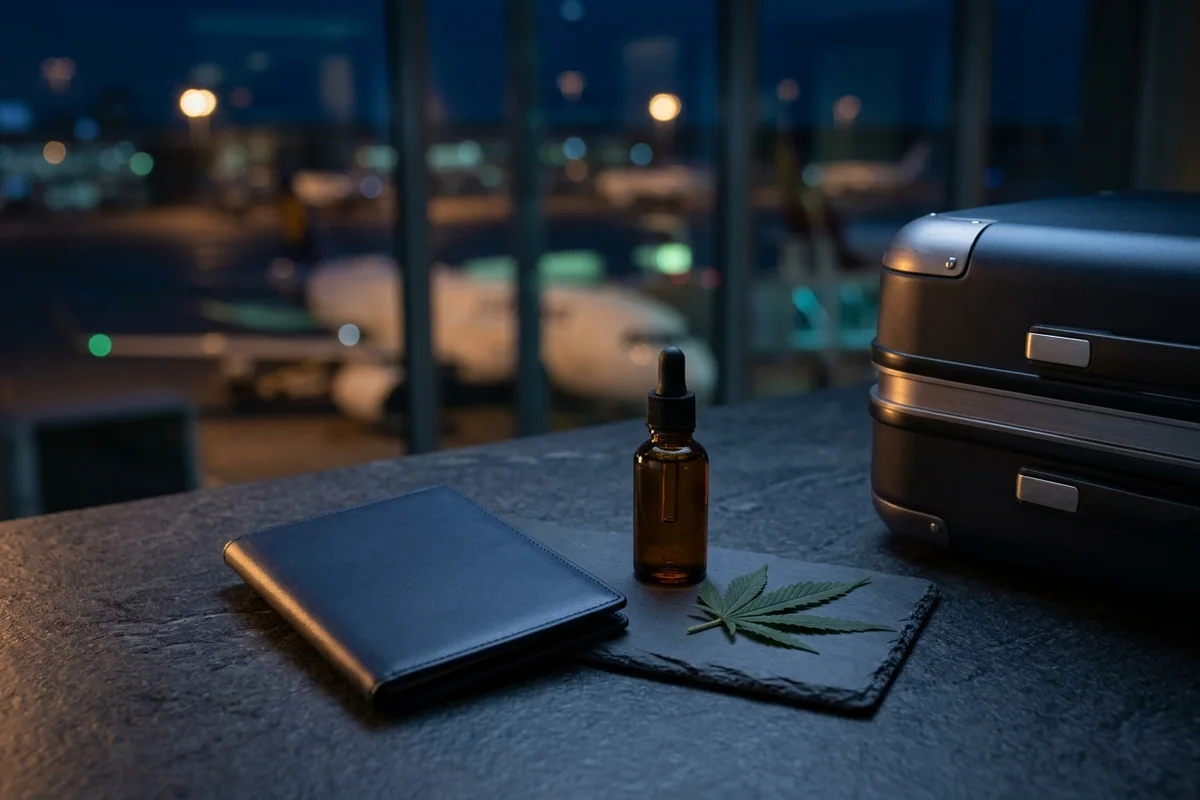
A right to buy or use cannabis in Thailand is not a right to import or export it. Controlled herb rules, Customs Act Sections 242 and 244, and severe overseas penalties.
Buying cannabis from a shop in Thailand may lead tourists to assume they can pack it in their luggage and take it home. But the right to buy or use cannabis within a country and the right to import or export it are two separate matters. A receipt or a medical prescription does not take the place of a cross-border permit.
On 12 July 2026, the Thai government warned travellers about agreeing to hold or carry cannabis out of the country for others, and announced stricter inspections. This reflects that the risk is not limited to large-scale traffickers: it can also fall on travellers who accept bags or items from other people.
In Thailand, the Ministry of Public Health Notification on Controlled Herbs (Cannabis) B.E. 2568 (2025) designates cannabis flower as a controlled herb. Supply to the general public for medical use must comply with the conditions on prescriptions issued by the professionals designated by law, and the amount supplied may not exceed what is needed for 30 days of treatment. The notification also prohibits sales through electronic channels and vending machines, as well as commercial advertising.
In 2026 there is also an amending Ministerial Regulation on licensing of controlled herb businesses. Operators must therefore check the qualifications and licence conditions that apply. A shop being open for business does not confirm that every sale or use of cannabis is lawful.
For international travel, travellers must check the rules of Thailand, the destination country and any transit country. They should identify clearly what they are carrying, whether flower, extract, medicine, food or another kind of product, because each type may fall under different laws and permit conditions. Having lawfully bought something in one country is no evidence that it may be imported into another.
In particular, oils, extracts and products containing THC should not be assumed lawful on the strength of the words “medical cannabis” or “CBD” on the label. You must check the ingredients, the source and the import requirements. Some products may also fall under narcotics law or health product law.
If cannabis is smuggled across a border, customs liability must be considered according to the nature of the act. The key differences are as follows.
- Section 242: Importing or exporting goods that have not gone through customs formalities carries imprisonment of up to 10 years, or a fine of four times the value of the goods plus duty, or both, and the goods are forfeited.
- Section 244: Bringing goods that have passed or are passing through customs formalities into or out of the country, including transit or transshipment, in a way that evades restrictions or prohibitions, carries imprisonment of up to 10 years, or a fine of up to THB 500,000, or both, and the court may order the goods forfeited.⁵
It is therefore wrong to say generally that every case of taking cannabis across a border carries a fine of four times the value, or that every case is the same offence. In addition, breaching the licensing requirements under Section 46 of the Protection and Promotion of Traditional Thai Medicinal Intelligence Act B.E. 2542 (1999) may be punishable under Section 78 by imprisonment of up to one year, or a fine of up to THB 20,000, or both, depending on the elements of the offence.
Destination-country laws may be stricter than travellers expect. For example, Hong Kong controls both THC and CBD cannabis. Import and export must comply with the dangerous drugs law, and the maximum penalty for drug trafficking offences may be life imprisonment and a fine of HK$5 million. Unlawful possession is a separate offence, with a maximum penalty of seven years’ imprisonment and a fine of HK$1 million. The offences must therefore be clearly distinguished.
Before travelling, check your luggage yourself, do not take charge of items whose contents or origin you do not know, and ask the customs authority or regulator of each country involved in advance. If you need to use a product for medical treatment, find out exactly whether it can be imported, what permission is needed and what quantity limits apply.
If you are stopped or accused, cooperate, ask what the allegation is, and seek help from a lawyer, including an interpreter if you do not understand the language, before signing any document that could affect the case.
A smooth trip starts with checking everything before you pack, because being permitted to use cannabis in Thailand does not mean you are permitted to carry it across a border.
Footnotes
- Office of the Permanent Secretary, Prime Minister’s Office, Government warns travellers: carrying or holding items for others may make them victims of transnational cannabis smuggling networks (in Thai), 12 July 2026
- Ministry of Public Health, Notification on Controlled Herbs (Cannabis) B.E. 2568 (2025) (in Thai); see also Government clarification on prescriptions and sales restrictions (in Thai)
- Department of Thai Traditional and Alternative Medicine, Ministerial Regulation on permission to study, research or export controlled herbs, or to sell or process controlled herbs commercially, and the 2026 amendment (in Thai), amendment announced in the Royal Gazette on 30 April 2026
- Customs Department, Points to know about importing parts and products of cannabis and hemp (in Thai), information in the document as of 29 November 2023, used as a reference for product classification and import requirements
- Customs Department, Customs Act B.E. 2560 (2017), Section 242, the offence of smuggling (in Thai) and Section 244, the offence of evading restrictions or prohibitions (in Thai)
- Medical Cannabis Division, News on enforcement of the controlled herb law, explaining the offence under Section 46 and the penalty under Section 78 (in Thai)
- Hong Kong Customs and Excise Department, Smart Guide to Passenger Clearance; Hong Kong Police Force, Laws & Penalties